11 Press-On Nail Application Mistakes (And How to Fix Them)
Quick answer
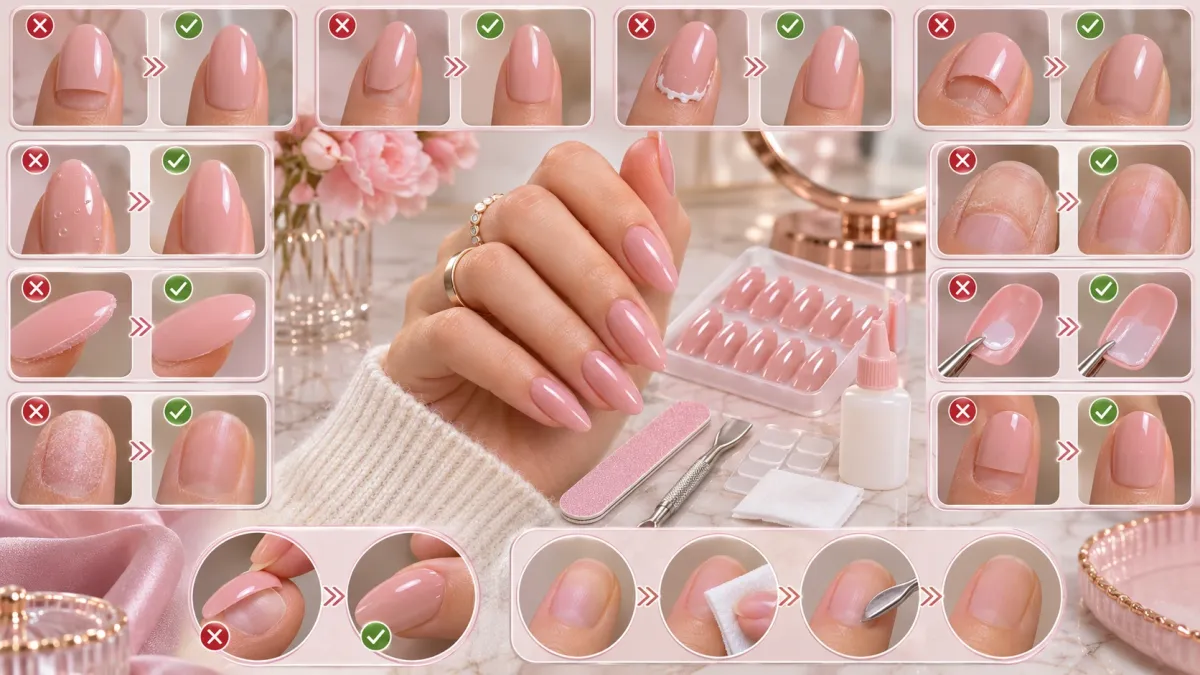
The most common press-on nail mistakes are skipping oil removal, leaving skin on the nail plate, choosing sizes by eye, using too much glue, pressing the tip flat instead of rolling it down from the cuticle, and getting your hands wet too soon. Each one causes lifting or a fake look, and each has a simple fix.
In this guide
- Press-on nail mistakes at a glance
- 1. Leaving oil on your nails
- 2. Leaving skin on the nail plate
- 3. Buffing too hard
- 4. Choosing sizes by eye
- 5. Using too much glue
- 6. Letting glue or the tip touch your skin
- 7. Pressing the tip flat from the top
- 8. Pressing only the center, or not long enough
- 9. Getting your hands wet too soon
- 10. Adding glue to pre-glued nails
- 11. Choosing a length that fights your day
- One more: prying them off
- How to avoid mistakes on your next set
- Sources
When a set of press-ons looks bad or falls off early, it almost never means you are "bad at nails." It means one small step went wrong. Most problems come from one of eleven common mistakes, and once you know them, you can fix most of them in seconds. When a set goes wrong, I work backward through the steps, starting with prep, because that is where a small slip is easiest to miss. On a first set, the two mistakes I would watch most closely are oil left on the nail and sizes chosen by eye, because those two are behind many of the sets that fail in the first few days.
For the full method from start to finish, see my step-by-step guide to applying press-ons. Below are the mistakes, what they cause, and how to fix each one.
Press-on nail mistakes at a glance
| Mistake | What you notice | Quick fix |
|---|---|---|
| Oil left on the nail | Nails pop off in a day or two | Wipe with alcohol right before applying |
| Skin on the nail plate | Lifting at the cuticle | Push cuticles back and clear the plate |
| Over-buffing | Thin, sore nails | Two light passes with a fine buffer |
| Sizing by eye | Visible edges or bulky tips | Test every finger before gluing |
| Too much glue | Glue on skin, messy sides | Thin layers only |
| Tip resting on skin | Lifting, discomfort | File the sides or size down |
| Pressing flat from the top | Air bubbles | Roll down from the cuticle at an angle |
| Pressing only the center | Sides lift | Press center, then each side, and hold |
| Water too soon | Nails loosen on day one | Keep hands dry for an hour |
| Extra glue on pre-glued nails | A less reliable hold | Use the built-in adhesive alone |
| Lengths that fight your day | Snapping or popping off | Choose a shorter length |
1. Leaving oil on your nails
Leaving oil on the nail is the number one mistake. Natural oil, hand cream or cuticle oil on the nail stops the adhesive bonding, and the set pops off in a day or two. Celebrity manicurist Gina Edwards puts it simply in NewBeauty's guide: oil on your hands or nails shortens the life of a set.
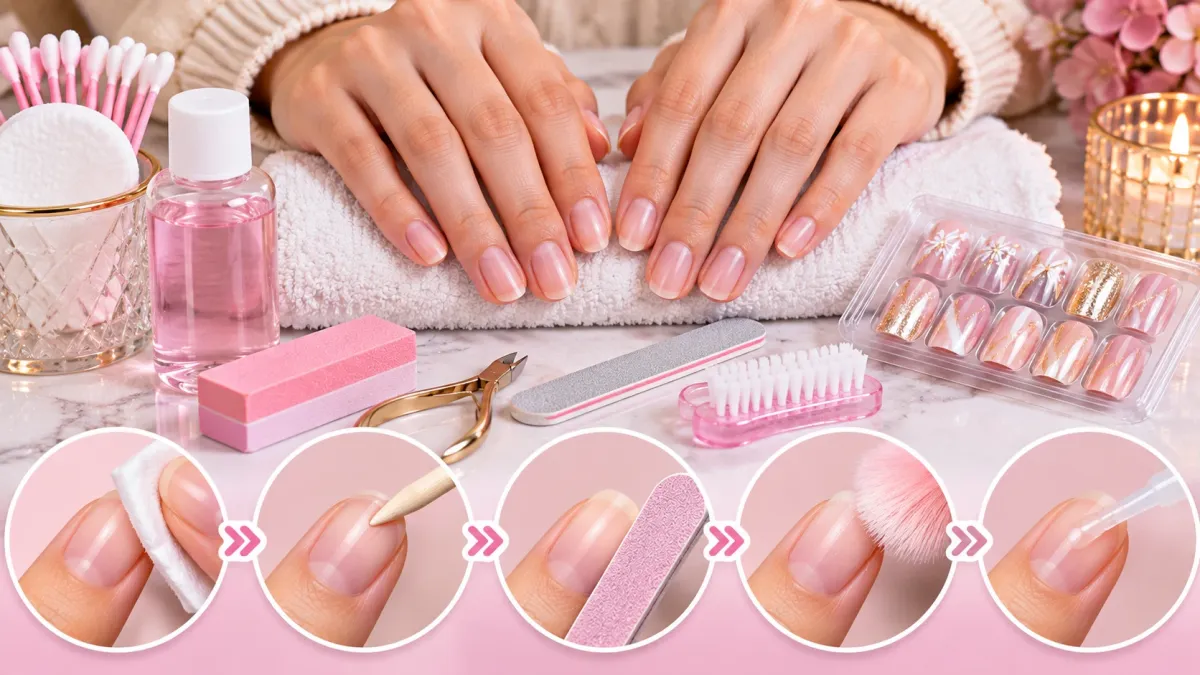
Fix: wipe every nail with rubbing alcohol on a lint-free pad right before applying, and do not touch the nail plates afterward. My full nail prep routine shows each step.
2. Leaving skin on the nail plate
A thin layer of cuticle skin often sticks to the base of the nail. Glue bonds to that skin, the skin moves, and the press-on lifts at the cuticle.
Fix: gently push back your cuticles and look closely at the base of each nail before you buff. Never cut the cuticle itself. My guide to gentle cuticle prep shows how.
3. Buffing too hard
A light buff helps, but heavy buffing thins your nail, and a thinned nail bends and peels more easily under the next set.
Fix: use a fine buffer for two or three light passes, just until the shine is gone.
4. Choosing sizes by eye
Picking sizes by looking at the box, or using the same size on both hands, is the main reason sets look fake. A tip that is too small leaves your nail edges showing and can pinch; a tip that is too big sits on skin and lifts. Bailey Stanworth, founder of Quickies Press On Nails, told Byrdie that nails that are too small can damage your natural nail by pressing on it.
Fix: hold each tip against each nail before opening the glue. It should cover the nail from sidewall to sidewall without touching skin. I size both hands separately every time, because the same finger on each hand can need a different size. My full press-on sizing method includes a chart, and if your tips are too wide, see how to file wide press-ons to fit.
5. Using too much glue
More glue does not mean more hold. Excess glue squeezes out at the sides, sets on your skin, and makes removal harder. Tom Bachik, a celebrity manicurist, warned Essence that too much glue can squeeze out all over the fingers.
Fix: a thin layer on your nail and a thin layer on the back of the tip is enough. My rule is a layer thin enough that nothing beads at the edges when I press. Work on one nail at a time.
6. Letting glue or the tip touch your skin
When glue or the edge of the tip touches skin, the skin pulls it up as you move, and it can feel uncomfortable. Glue on skin is also how irritation starts.
Fix: keep each tip just short of the skin, file the sides of a tip that is slightly too wide, and wipe away any glue on skin before it sets. If glue does get on your skin, follow my guide to removing glue from skin safely.
7. Pressing the tip flat from the top
Dropping a tip straight down onto the nail traps air underneath. You will see a cloudy patch or bubble, and that area will lift first.
Fix: place the tip at the cuticle at a slight angle, then roll it down toward the free edge so air is pushed out. If a bubble has already formed, read my guide to fixing air bubbles under press-ons.
8. Pressing only the center, or not long enough
A quick tap in the middle leaves the sides unsealed, and the edges start lifting within hours.
Fix: press firmly in the center, then on each side, and hold for 20 to 30 seconds per nail. My guide on how long to hold each press-on explains why the timing matters.
9. Getting your hands wet too soon
A fresh bond is at its weakest in the first hour. Washing dishes, showering or swimming straight after applying is a common reason sets loosen on day one.
Fix: keep your hands dry for at least an hour, and avoid long hot water for the rest of the day. For everyday water questions, see showering and swimming with press-ons.
10. Adding glue to pre-glued nails
Adding glue for extra hold seems logical, but on pre-glued sets it can backfire. imPRESS advises against adding extra glue, saying it may alter the effectiveness of its built-in adhesive.
Fix: use pre-glued nails as designed, with good prep. If you want glue, buy glue-on nails instead.
11. Choosing a length that fights your day
Long tips act like a lever. If you type, cook, clean or work with your hands a lot, a long set takes knocks that pop it off or snap it.
Fix: choose a short or medium length for everyday wear and save long sets for events. My guide to press-on lengths helps you pick one that suits your routine.
One more: prying them off
Prying is a removal mistake, not an application one, but it is the mistake that causes the most damage. Prying or peeling off a press-on can take layers of your natural nail with it, which makes your next set harder to apply too.
Fix: always soak until the nail releases on its own. My guide to gentle press-on removal lists five methods.
How to avoid mistakes on your next set
Most mistakes happen because the order of steps gets mixed up or rushed. Lay out everything first, size every finger before prepping, prep right before applying, and do one nail at a time. Having the right tools within reach helps too; my press-on tools checklist lists what to set out.
If your problem is that the set looks fake rather than that it falls off, the tips in my guide to natural-looking press-on nails will help most.
Sources
Frequently asked questions
Why do my press-on nails look bad?
Press-ons usually look bad because of the wrong size, a gap at the cuticle, glue on the skin, or a length that does not suit your hands. Sizing every finger and placing each tip right at the cuticle fixes most of it.
What is the biggest mistake people make with press-ons?
Skipping oil removal. Natural oil and lotion on the nail stop the adhesive from bonding, so the set lifts within a day or two even if everything else is right.
Why are my press-ons lifting at the cuticle?
Lifting at the cuticle usually comes from skin left on the nail plate, oil, or a tip that rests on the skin. Push your cuticles back, wipe with alcohol, and place the tip just short of the skin.
Is it bad to use a lot of nail glue?
Yes. Too much glue spreads onto your skin, makes removal harder and does not improve the hold. A thin layer on the nail and on the tip is enough.
How do I stop air bubbles under press-ons?
Place each tip at the cuticle at a slight angle and roll it down toward the free edge, pressing as you go. This pushes air out instead of trapping it under the nail.

Written by Ome Jack
I'm Ome Jack, the owner and writer of OmeNails. I've worked with nails for 11 years and run my own nail business. Here I write step-by-step guides on choosing, applying, fixing and removing press-on nails, based on years of hands-on work with real clients'…
More about Ome