Do Press-On Nails Damage Your Natural Nails? What Actually Causes Damage
Quick answer
Press-on nails do not damage your nails by themselves. Damage usually comes from prying or peeling them off, over-buffing, using too much glue, wearing sets back to back, or gaps that trap water. Applied gently, worn for up to two weeks and soaked off slowly, they are one of the gentler artificial nail options.
In this guide
- Do press-on nails damage your nails? The short answer
- What actually causes damage from press-on nails
- Are press-on nails safe? Allergies and infections
- Allergic reactions to glue or adhesive
- Infection from trapped moisture
- Glue vs tabs: which is gentler on your nails?
- Press-ons vs acrylic and gel for nail health
- How to wear press-ons without damaging your nails
- Signs your nails need a break
- Sources
Thin, peeling, chalky nails after a set of press-ons rarely come from the press-ons themselves. Most often they come from the minute someone got impatient and pulled a set off. That is why, when I take a set off, I treat removal as part of the manicure, never a job to rush.
So, do press-on nails damage your nails? Here is what actually causes damage, what dermatologists say about safety, and the habits that keep your nails healthy between sets. If you are new to press-ons, my explainer on how press-on nails work covers the basics first.
Do press-on nails damage your nails? The short answer
Press-on nails do not damage your nails on their own. The damage comes from how they are applied, worn and removed. Board-certified dermatologist Dr. Hannah Kopelman told NBC Select that, in her patients, the nails themselves do not usually cause the problem, and that removal is where she sees most of the damage.
That is good news, because every one of the causes below is something you control. Press-ons also skip the heavy filing that acrylics need. The American Academy of Dermatology explains that to make acrylic nails stick, the natural nail is filed until it feels rough, which thins it. Press-ons only need a light buff.
What actually causes damage from press-on nails
Seven habits cause most press-on damage, and the first one, prying, is the biggest.
- Prying or peeling nails off. When a press-on is still bonded and you pull it, the glue can take the top layers of your natural nail with it. That is what leaves nails thin, bendy and patchy. If a nail still clings after the soak, I give it a few more minutes in the water rather than any extra force.
- Over-buffing. A light buff to remove shine is all you need, and when I prep, I stop the moment the shine is gone. Dr. Kopelman warns that over-buffing thins the nail and makes it more vulnerable.
- Too much glue. A thick layer does not hold better; it spreads onto the skin, makes removal harder and, with repeated use, can dry out the nail plate.
- Wearing sets back to back. Your nails need time to recover between sets. Dr. Kopelman lists constant back-to-back wear, with no break for your natural nails, among the habits behind damage.
- Gaps that trap water. A gap at the edge lets water and dirt sit under the tip. Dr. Taryn Murray of Cleveland Clinic explains that press-ons can trap moisture and create a damp environment where fungus and bacteria can grow.
- The wrong size. A tip that is too narrow presses into the sides of your nail, and one that is too wide sits on skin and lifts. If a set ever feels sore, read why press-ons can hurt and how to fix it.
- Very long tips. Length acts like a lever. Dr. Murray explains that a longer nail is more likely to lift the natural nail away from the nail bed beneath it. Short and medium lengths are kinder to your nails.
Are press-on nails safe? Allergies and infections
For most people with healthy nails, press-ons are safe when used sensibly, but two risks are worth knowing about: adhesive allergies and infection from trapped moisture.
Allergic reactions to glue or adhesive
Nail glues and some adhesives contain acrylate chemicals, and some people react to them. Dr. Murray of Cleveland Clinic notes that you can react to the press-on itself or to its glue, and that an allergy to these ingredients can develop at any time. TIME has reported that the rise in home use of gel and acrylic products has led to far more acrylate allergy cases than normal, and that even the glue used with press-on nails contains acrylates. The risk is higher when gel is not cured long enough, which is easier to get wrong with a home kit.
Two simple habits lower the chance of trouble. First, keep glue off your skin; my guide to getting nail glue off skin gently helps if it happens. Second, if you are trying a new product, test it on one nail first to check for a reaction. I give a new glue a full day on that one nail before I use it on a whole set.
Infection from trapped moisture
The second risk is a gap that holds water against your nail. Good sizing, clean prep and removing a set before it starts lifting all prevent this.
Stop and see a doctor if the skin around a nail becomes red, swollen, itchy or tender, or if you notice discoloration of the nail. The same applies if a rash appears on your hands or face after applying a set. Remove the press-ons and see a dermatologist rather than covering the problem with another set.
Glue vs tabs: which is gentler on your nails?
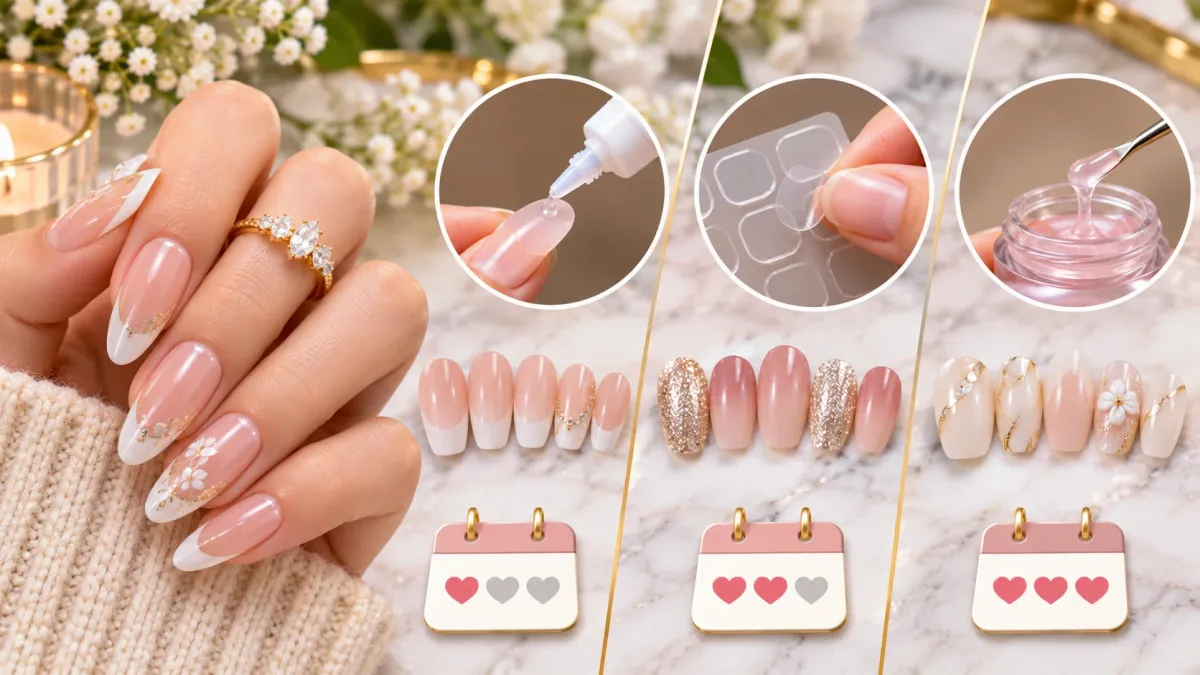
Adhesive tabs are gentler than glue, but they do not last as long. Dr. Kopelman calls tab-style press-ons much gentler on the nail, and suggests them for a night out or a special occasion, since they do not last as long. Glue gives longer wear but needs more patience to remove.
My rule of thumb: tabs for a few days or a special event, glue when you want a week or more and are willing to soak properly at the end. The full comparison, including cost and wear time, is in my guide to choosing glue or tabs for press-ons.
Press-ons vs acrylic and gel for nail health
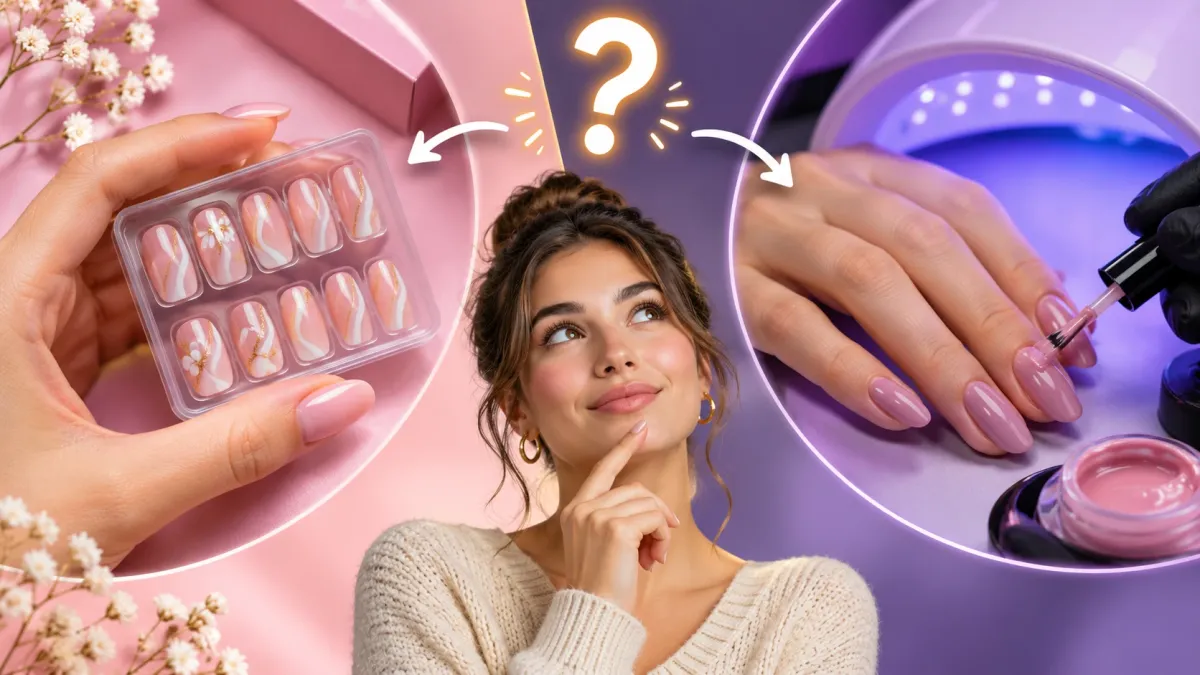
Compared with acrylic, press-ons are usually easier on your nails because they need no heavy filing and no long acetone soaks when you use tabs. Compared with gel polish, the main difference is removal: gel is soaked in acetone, while press-ons can often come off with warm, soapy water and oil.
The details depend on the products and on how carefully each is removed. I compare them side by side in press-ons or acrylics for your nails and press-ons or gel polish.
How to wear press-ons without damaging your nails
Follow these steps and press-ons can be part of your routine without wearing your nails down.
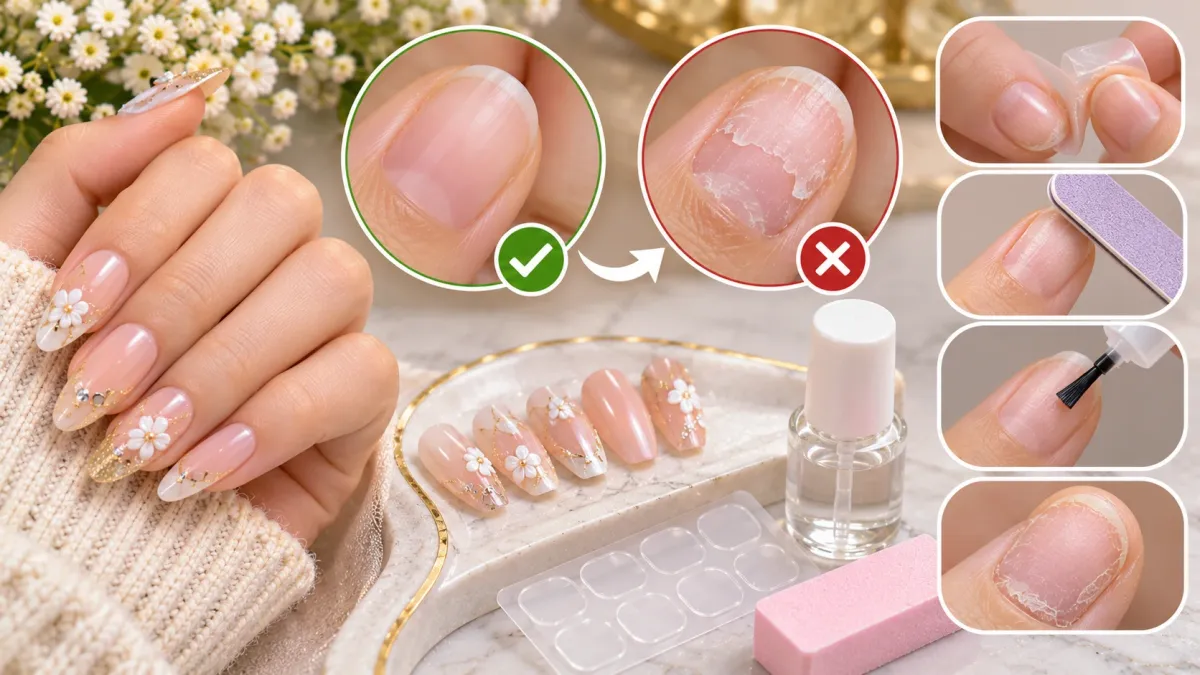
- Start with healthy nails. Do not cover broken, sore or problem nails with a set. The AAD advises against using artificial nails to hide nail problems.
- Prep gently. Push cuticles back softly, buff only enough to take the shine off, and wipe with alcohol. My nail prep routine for press-ons shows each step.
- Size every finger. No tip should touch skin or leave nail uncovered at the sides.
- Use glue sparingly. A thin layer is enough, and none should reach the skin.
- Wear gloves for long jobs in water. Dishes and cleaning are where most lifting starts.
- Remove within about two weeks. I explain why in how long a set should stay on.
- Soak, never pry. Warm, soapy water with a little oil loosens most sets. My guide on removing press-ons without hurting your nails covers five methods.
Signs your nails need a break
Your nails need a break from press-ons when they feel thinner, bend more than usual, peel in layers, look chalky in patches, or feel sore when you press on them. These are signs the surface needs time to recover.
When you see them, skip your next set for a while, keep your nails short, and moisturize them daily. A moisturizing hand cream helps too, especially after using removers. A step-by-step routine for this is in my guide to nail care after taking press-ons off.
My tip: once a set has been on for about two weeks, a week or two off is a sensible guide. Going straight into a new set is fine too, as long as your nails feel firm, smooth and comfortable once you have given them a day or two of care. I fill that time with cuticle oil and a good hand cream, and the next set sticks better on healthy nails.
Sources
Frequently asked questions
Are press-on nails bad for your nails?
Not on their own. Most damage comes from prying them off, over-buffing, heavy glue use or wearing sets back to back. Applied gently and soaked off slowly, press-ons are one of the gentler ways to wear artificial nails.
Are press-on nails safe to wear every week?
Wearing set after set with no break can leave nails brittle and thin over time. After about two weeks of wear, a break of a week or two is a sensible guide. If you go straight into a new set, your nails should feel firm, smooth and comfortable after a day or two of care. Stop if they feel sore or thin.
Is nail glue bad for your nails?
Nail glue is not harmful when used in a thin layer and removed by soaking. Problems come from thick layers, glue on the skin, and pulling nails off before the glue softens. Stop using a glue if your skin reacts to it.
Are adhesive tabs safer than glue?
Tabs are gentler because they release more easily, which lowers the risk of peeling your natural nail during removal. They do not last as long, so they suit short wear or special events.
What should I do if my skin reacts to press-on nails?
Remove the set, wash your hands, and avoid the product. If redness, itching, swelling or a rash continues, see a dermatologist, who can check whether you are reacting to an ingredient in the glue or adhesive.

Written by Ome Jack
I'm Ome Jack, the owner and writer of OmeNails. I've worked with nails for 11 years and run my own nail business. Here I write step-by-step guides on choosing, applying, fixing and removing press-on nails, based on years of hands-on work with real clients'…
More about Ome