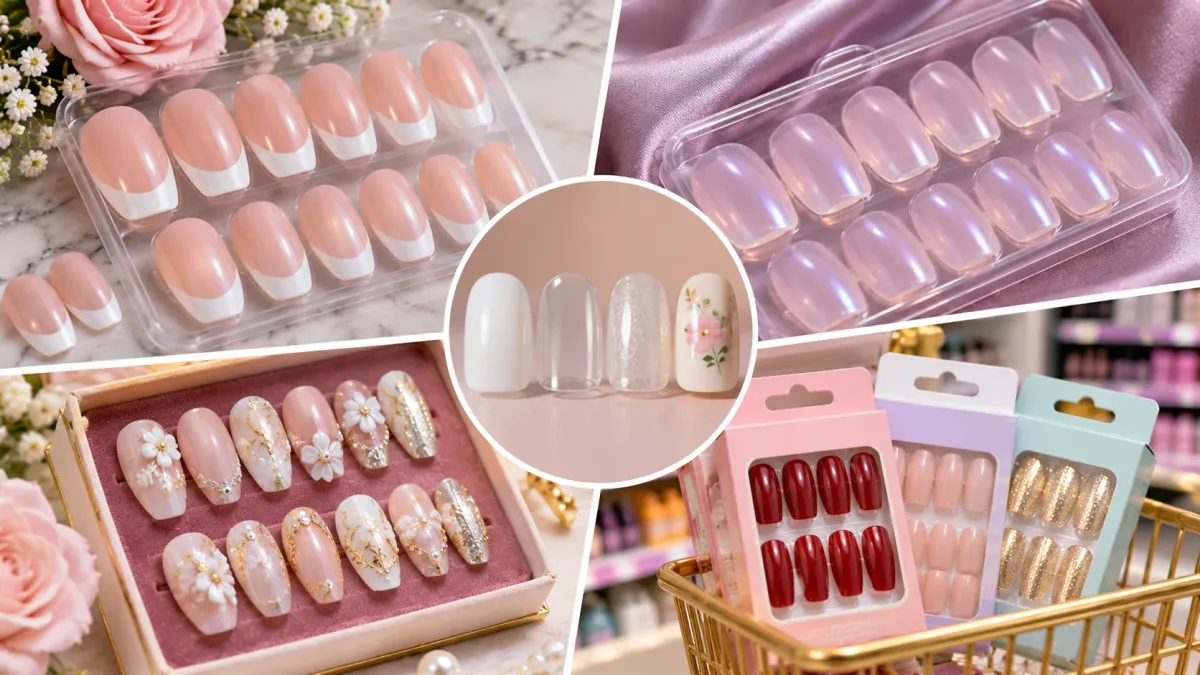
What Are Press-On Nails? Types, Materials & How They Work
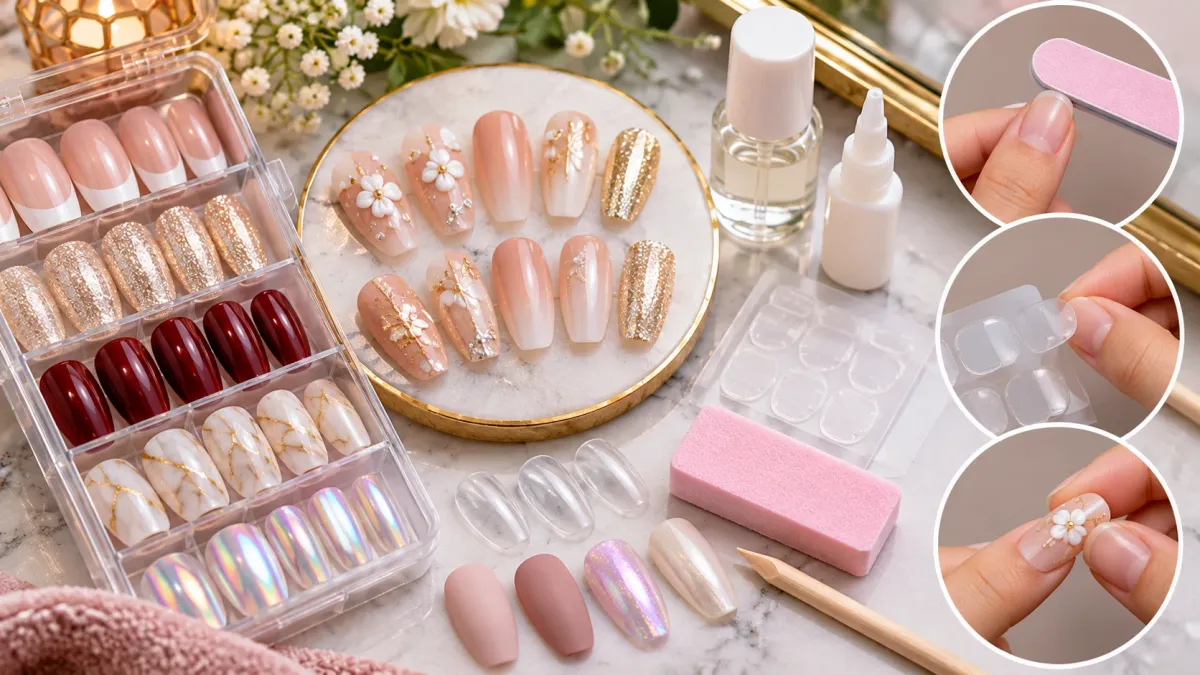
Quick answer
Press-on nails are ready-made artificial nails that cover your whole natural nail and attach at home with nail glue, adhesive tabs or a gel adhesive. Most are made of ABS plastic or soft gel, come in a box of sizes, and last from a few days to about two weeks.
In this guide
- What are press-on nails?
- How do press-on nails work?
- What are press-on nails made of?
- The main types of press-on nails
- How long do press-on nails last?
- Are press-on nails bad for your natural nails?
- Press-on nails vs other manicures
- Are press-on nails worth it?
- Who press-on nails suit best
- Key press-on nail terms
- Where press-on nails came from
- How to get started with your first set
- Sources
I have worked with nails for 11 years, and press-ons are one of the most misunderstood products in the nail aisle. They are not the thick, shiny claws of the 1990s anymore, and they are not the same thing as acrylics.
Below I explain what press-on nails actually are, what they are made of and how they stay on. I also cover the main types you will find and how they compare with salon services, so you can decide if they fit your life. If you are brand new and want the whole process on one page, from buying to removal, start with my beginner's guide to press-ons.
What are press-on nails?
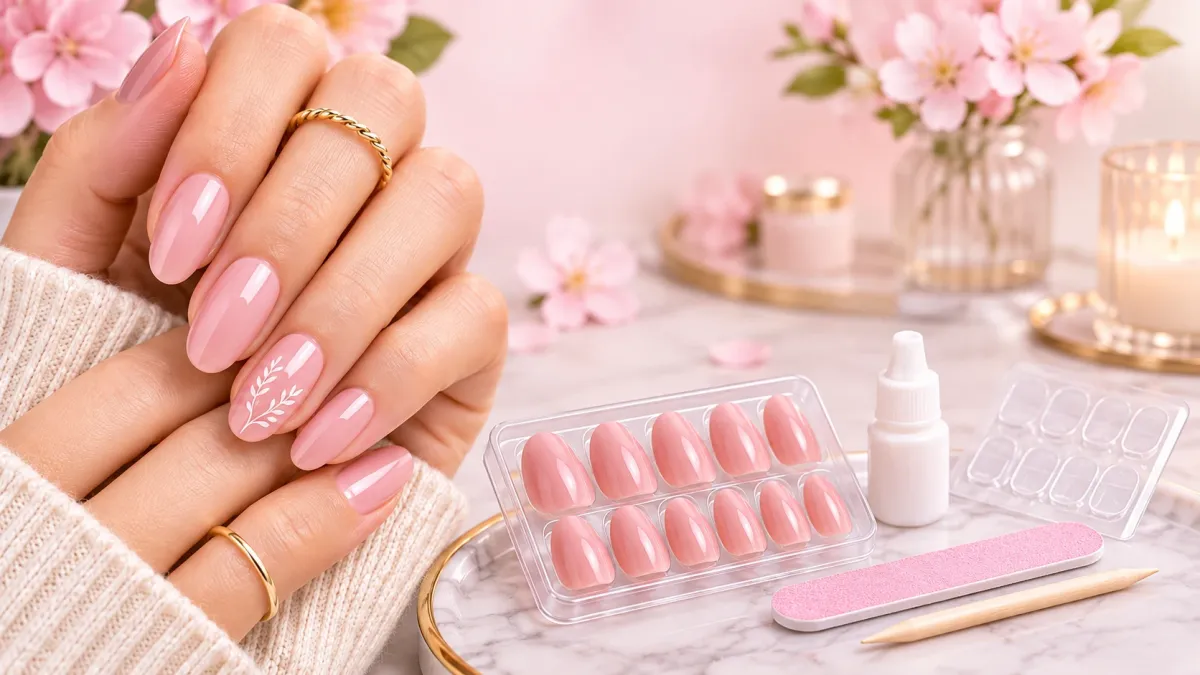
Press-on nails are pre-made artificial nails that you attach over your natural nails yourself. Each one is already shaped, and usually already colored or decorated, so the whole manicure is finished before you open the box. You choose a size for each finger, prep your nails, and stick the tips on with nail glue, double-sided adhesive tabs, or in some kits a gel adhesive.
Sally Beauty describes them as pre-designed artificial nails applied with adhesive tabs or nail glue to give a salon look at home. That is the whole idea: the design work happens in the factory or the nail artist's studio, and you only do the fitting.
Are press-on nails fake nails?
Yes. "Fake nails" and "artificial nails" are umbrella terms, and press-ons are one kind. Acrylics, hard gel extensions and soft gel extensions such as Gel-X are other kinds. The difference is how they are made: acrylic and hard gel are built and sculpted on your nail from liquid or powder products, while a press-on arrives finished and is simply attached.
How do press-on nails work?
Press-on nails work by giving you a finished nail shell that fits over your own nail plate and a layer of adhesive that holds it there. Three things decide whether a set looks natural and stays on: the size, the curve and the adhesive.
- Size: each tip should cover your nail from one side to the other without touching the skin. Boxes come with several sizes, usually numbered. The largest is usually a zero, meant for thumbs.
- Curve: the underside of each tip is curved to sit on the arch of your nail. When the curve of the tip matches your nail, the adhesive has full contact and there is no gap for water to creep into.
- Adhesive: glue, tabs or gel adhesive fills the space between the two surfaces and bonds them.
When all three line up, a press-on behaves like a thin protective shell. When one is off, you get lifting, pinching or a nail that pops off. That is why my advice to beginners is to spend more time on press-on nail sizing than on anything else. The fit mistake I would warn you about first is a tip that is too narrow: forced onto the nail, it lifts at the sides or develops hairline cracks.
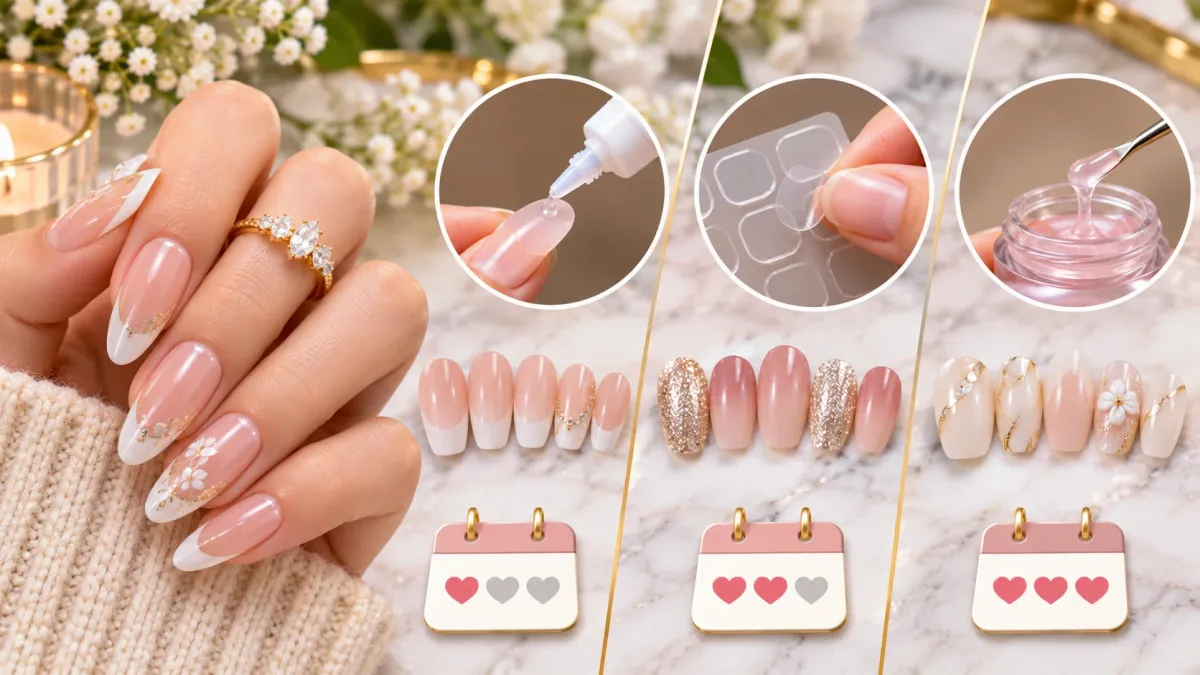
The three ways press-ons stay on
| Adhesive | How it bonds | Best for |
|---|---|---|
| Nail glue | Liquid cyanoacrylate that hardens on contact with moisture | The longest wear, often around one to two weeks |
| Adhesive tabs | Double-sided sticky pads that grip when pressed | Short wear, a weekend or a special event |
| Gel adhesive | A gel that hardens under a UV or LED lamp | Soft gel tips and salon-style, long wear |
Most nail glues are cyanoacrylate, the same family of fast-setting adhesive as super glue, formulated for nails. In an OPI explainer for Skin Inc, the chemistry is described simply: cyanoacrylate cures on contact with moisture in the air or on the nail, which is why it sets in seconds. OPI's own product page for its xPRESS/ON kits lists the ingredients as ABS plastic for the nails and ethyl cyanoacrylate for the glue.
Some sets skip the separate glue entirely. Pre-glued brands such as imPRESS and Dashing Diva's Magic Press put an adhesive layer on the back of each nail; Dashing Diva says its nails need no glue at all unless you want more than a week of wear. If you are weighing these options, my full comparison of glue vs tabs for press-ons goes through wear time, damage risk and cost.
What are press-on nails made of?
Almost all press-on nails are made of plastic, and the most common one by far is ABS (acrylonitrile butadiene styrene). It is light, tough, easy to mold, and easy to file. Check the ingredient list on most drugstore boxes and you will usually see ABS listed for the nails and a cyanoacrylate for the glue.
| Material | What it feels like | Where you see it |
|---|---|---|
| ABS plastic | Light, sturdy, a little flexible, files easily | Most drugstore and pre-glued sets |
| PMMA (acrylic resin) | Rigid and very glossy | Clear or glass-look tips |
| Soft gel | Thin, flexible, gel-like | Soft gel kits and Gel-X style extensions |
| Gel polish over a tip | Depends on the base tip; usually thicker and stronger | Handmade and custom sets |
A useful note: ABS is not automatically low-end. It is a tough, easy-to-mold plastic, and its cheap reputation comes from how many budget sets use it. Soft gel tips belong to a UV/LED-curable gel system that is usually removed by soaking in acetone. In other words, the material tells you how the nail behaves and how it comes off, not whether it is good quality. Fit and finish matter more.
Handmade press-ons are usually plastic or soft gel tips painted by an artist with gel polish and cured under a lamp. That extra gel layer is a big part of why a good handmade set can be worn again and again.
The main types of press-on nails
The four types you will meet most are classic drugstore sets, pre-glued sets, soft gel sets and handmade sets. Each one suits a different kind of wearer.
| Type | How it attaches | Reusable? | Good for |
|---|---|---|---|
| Classic drugstore (ABS) | Glue or tabs included in the box | Sometimes, if removed gently | Beginners and budget sets |
| Pre-glued | Adhesive already on each nail | Usually not | Speed and short wear |
| Soft gel | Glue, tabs or gel adhesive with a lamp | Often, depending on removal | A natural, thin look |
| Handmade or custom | Glue or tabs | Yes, many times with care | Detailed art and exact sizes |
Pre-glued sets are worth a special note. Dashing Diva says plainly that its Magic Press nails are made for one-time use only. Handmade sets are the opposite: they are built to be worn many times. For a closer look at each category, read my guide to the different kinds of press-on nails, and if the thin, flexible kind appeals to you, start with my soft gel press-ons explainer.
How long do press-on nails last?
Press-on nails last anywhere from a day to about two weeks, and the adhesive is the biggest factor. Tabs are made for short wear, glue for longer wear, and pre-glued kits sit in between. For example, Dashing Diva rates its pre-glued Magic Press nails at up to 10 days, and imPRESS promises up to 7.
Your nails and your routine matter almost as much. Oily nail plates, long soaks in hot water and using your nails as tools all shorten wear. I break down realistic numbers in how long press-ons last with glue, tabs and gel, and the habits that add days are in my guide on keeping press-ons on longer.
Are press-on nails bad for your natural nails?
Press-on nails are one of the gentler ways to wear artificial nails when they are applied to healthy nails and removed slowly. The American Academy of Dermatology notes that acrylic nails need the natural nail filed until it feels rough, which thins it. Press-ons only need a light buff to take the shine off, so that step is far less harsh.
The real risks come from three places: prying nails off instead of soaking them, wearing sets back to back without a break, and a reaction to the adhesive. Of the three, prying is the one I worry about most, because it can pull thin layers of your natural nail away with the glue. Dermatologists also advise against using artificial nails to hide nails that are already brittle or damaged, because covering them can make things worse. If the skin around your nails turns red, itchy, swollen or painful, take the set off and see a doctor or dermatologist.
I go through what causes damage and how to avoid it in are press-on nails bad for your nails. The safest way to take a set off is in my guide on removing press-ons without damage.
Press-on nails vs other manicures
Press-on nails are the fastest and most flexible option, but not always the longest wearing. Here is how they compare in general terms with other popular salon and at-home options.
| Option | Who applies it | Typical wear | Adds length? |
|---|---|---|---|
| Press-on nails | You, at home | A few days to about 2 weeks | Yes |
| Acrylic | Usually a nail tech | 2 to 3 weeks before a fill | Yes |
| Gel polish | Salon, or at home with a lamp | About 2 to 3 weeks | No |
| Semi-cured gel strips | You, with a small lamp | Around 1 to 2 weeks | No |
| Dip powder | Salon or at home | About 2 to 3 weeks | Only with tips |
Wear times vary by product and lifestyle, so treat these as typical ranges, not promises. If acrylics are your usual service, read press-ons vs acrylics. If you book gel manicures, my guide on press-ons vs a gel manicure is the one to read. Gel strip fans will find the differences in my comparison of press-ons and semi-cured gel strips, and dip lovers can check press-ons vs dip powder nails.
Are press-on nails worth it?
Press-on nails are worth it if you like changing your look often, want long nails without salon visits, or need a polished manicure on short notice. They are less worth it if you want three weeks of wear with zero maintenance, or if you work with your hands in water all day.
The honest list of upsides and downsides is in my pros and cons of press-ons. If money is the deciding factor, my guide to whether press-ons are worth the cost compares a year of press-ons with a year of salon visits.
Who press-on nails suit best
Press-ons are a great fit for these people:
- Busy people who want a finished manicure in under 30 minutes.
- Trend lovers who change designs every week or for every event.
- Anyone taking a break from acrylics or gel who still wants length and color.
- Short or bitten nails, as long as the tip covers the whole nail plate. My guide to press-ons on short nails covers the details.
They are a poorer fit if your nails are broken, sore or showing signs of a problem, if you react to nail adhesives, or if your job keeps your hands wet for hours. In those cases, wait, try a single nail first, or ask a dermatologist.
Key press-on nail terms
A few words come up again and again on boxes and in tutorials. Knowing them makes every guide easier to follow:
- C-curve: the side-to-side arch of a nail or tip, seen when you look at it from the free edge.
- Sidewalls: the two edges where your nail meets the skin at the sides.
- Cuticle area: the base of the nail, where the tip should sit just short of the skin.
- Free edge: the part of your natural nail that grows past the fingertip.
- Apex: the highest, strongest point of an enhancement, usually in the center.
For 30 terms explained in plain English, keep my press-on nail glossary open while you shop.
Where press-on nails came from
Press-on nails are not a new idea. Marie Claire notes that they reached the mass market in the 1970s, and that early versions were thicker, came in few styles and rarely included enough sizes for a good fit. Better materials, more sizes per box and better adhesives are the reason modern press-ons can look like a fresh salon set.
Their popularity has grown quickly in recent years. Cosmetic Executive Women reported NielsenIQ figures showing that sales of artificial nails, a group that includes press-ons, overtook nail polish sales in the fourth quarter of 2022. If you enjoy the backstory, read how press-on nails developed over the decades.
How to get started with your first set
The quickest route is simple. Choose a short or medium length in a shape you already like, and size every finger before you open the glue. Then prep your nails well and press each tip on firmly from the cuticle down. My step-by-step application guide walks through every stage, from prep to the final press.
Press-on nails in short:
- They are ready-made artificial nails you attach yourself.
- Most are ABS plastic or soft gel.
- Glue lasts longest, tabs are for short wear, and gel adhesive needs a lamp.
- A good fit matters more than the price of the set.
- Soak them off; never pry.
Sources
- Sally Beauty: What are press-on nails?
- Skin Inc (OPI): What are nail glues?
- OPI: xPRESS/ON Funny Bunny product page (ingredients)
- Dashing Diva: Magic Press FAQ (sizing, glue, wear, removal)
- imPRESS: Astound press-on manicure product page
- American Academy of Dermatology: Artificial nails
- Marie Claire: How press-on nails became a fashion accessory
- Cosmetic Executive Women: Artificial nail sales overtake nail polish
Frequently asked questions
What is the meaning of press-on nails?
Press-on nails are pre-made artificial nails that you attach to your own nails at home. They come already shaped and designed, and you hold them on with nail glue, adhesive tabs or a gel adhesive.
Are press-on nails the same as acrylic nails?
No. Acrylic nails are built on your natural nail from a liquid and powder that harden, usually by a nail tech. Press-ons arrive finished and are simply attached and later soaked off.
What are most press-on nails made of?
Most press-on nails are made of ABS plastic, a light and sturdy plastic that is easy to file. Soft gel press-ons use a flexible gel material instead, and handmade sets add layers of gel polish on top.
Do press-on nails need glue?
Not always. You can use nail glue, double-sided adhesive tabs, or a pre-glued set with adhesive already on each nail. Glue usually gives the longest wear, while tabs are better for a day or a weekend.
Which press-on nails can be reused?
Handmade sets are made to be worn many times, and many other sets can be reused if you remove them gently and clean the old adhesive off the back. Pre-glued sets are usually single use.
Written by Ome Jack
I'm Ome Jack, the owner and writer of OmeNails. I've worked with nails for 11 years and run my own nail business. Here I write step-by-step guides on choosing, applying, fixing and removing press-on nails, based on years of hands-on work with real clients'…
More about Ome